


New York — 14-15 May 2026
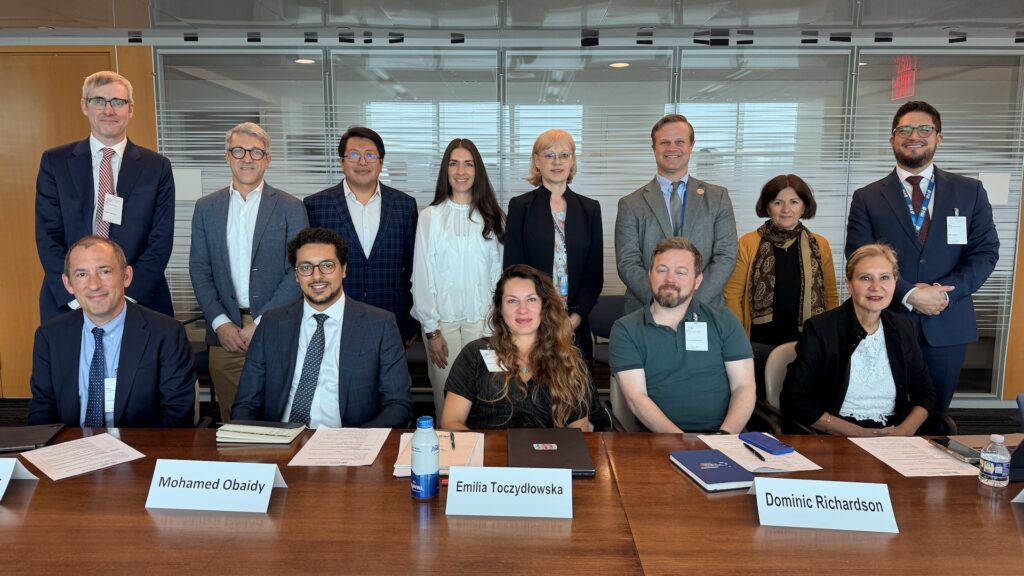
The International Federation for Family Development (IFFD) contributed to the United Nations Expert Group Meeting (EGM) on “Families, megatrends, inequalities and family and child wellbeing,” held at UN Headquarters in New York on 14–15 May 2026. The meeting was convened by the Division for Inclusive Social Development of the UN Department of Economic and Social Affairs (DISD/UNDESA).
IFFD was represented by José Alejandro (Alex) Vázquez, Director of International Relations, accompanied by Mamie Rogers throughout the two days of the meeting.
A meeting on megatrends, inequalities and the family
The Expert Group Meeting brought together academics, policymakers and civil society representatives to examine how global megatrends — technological change, demographic shifts, migration, urbanization and climate change — are widening inequalities and shaping the wellbeing of families and children. Opened by Renata Kaczmarska, Focal Point on the Family at DISD/UNDESA, the meeting unfolded across several working sessions designed for discussion and brainstorming rather than formal presentations.
The starting point was clear: although the family is recognized as the fundamental unit of society, families are too often inadequately supported by public systems, with spending on the youngest children remaining low and early intervention frequently treated as discretionary. The conclusions and recommendations of the meeting are set to feed into the forthcoming report of the Secretary-General to the 81st session of the General Assembly on the follow-up to the thirtieth anniversary of the International Year of the Family and beyond.
IFFD’s contribution: digital technologies and parenting
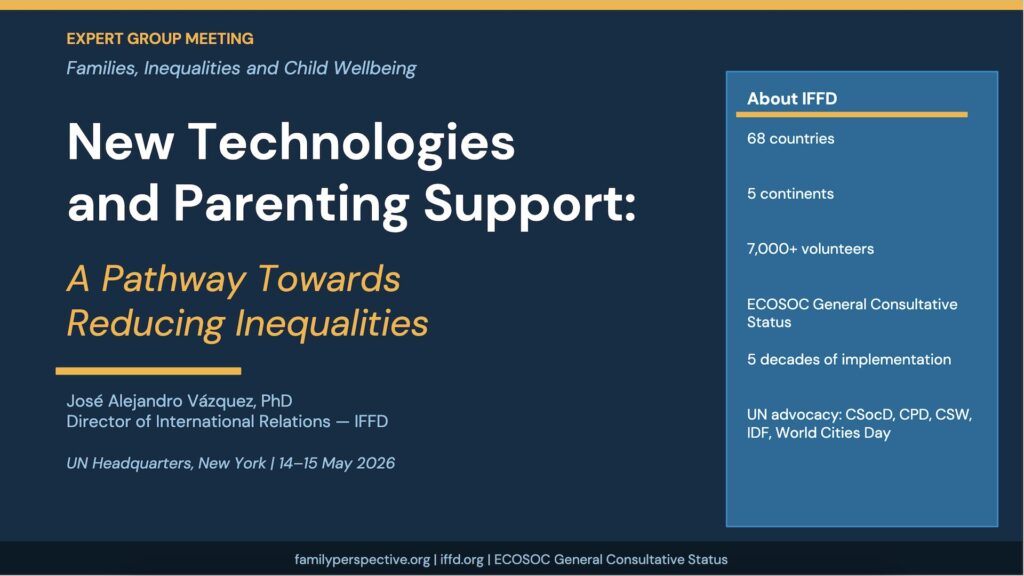
 IFFD’s substantive contribution came in the meeting’s first session, on megatrends, technological change and growing inequalities, moderated by Sergio P. Vieira of UNDESA. Alongside Professor Mihaela Robila of Queens College (City University of New York), Alex Vázquez presented on *”Digital technologies: challenges and opportunities for parenting,”* framing the digital environment as both a source of new inequalities and an opportunity to strengthen parenting support.
The discussion underscored how digital divides mirror existing socio-economic disparities — affecting access to devices, connectivity and skills across the entire life course, from children’s learning to caregivers and older adults. Participants weighed the risks of job polarization, screen time and online harms against the potential of well-designed digital tools to expand the reach of family life education and parenting programmes, particularly in low-connectivity and vulnerable settings. The prevailing view favored regulation, digital literacy and parental guidance over blanket restrictions.
IFFD’s intervention reflected a conviction the Federation brought to the room throughout the two days: that families do not need to be told what to do, but rather need governments and civil society to remove the economic, digital and social barriers that stand between them and their own potential.
Concrete proof that family-oriented policy works
In its statement to the meeting, IFFD argued that the gap between policy design and its real impact on families is itself a form of inequality — and that closing it is the work that matters most. Rather than offering only global recommendations, the Federation pointed to tangible results from its network across five continents and 68 countries:
– The Philippines, where Republic Act 11908 now mandates parenting support for every family in the country, including a dedicated module on the digital environment, with IFFD The Philippines leading its implementation as a programme.
– Kenya, host of an Action Plan, where the National Family Policy — co-drafted with UN-DESA, Strathmore University, IFFD Kenya and other civil society organizations — is moving from a document to a National Action Plan.
– Colombia, where the city of Envigado embedded family support into its municipal budget, reaching 750 families without waiting for extraordinary resources.
Envigado is far from alone. It belongs to a growing international network of more than 250 cities and regions that have signed the Venice Declaration on Inclusive Cities for Sustainable Families, encompassing more than 25 million people across Argentina, Brazil, Mexico, Colombia and Europe — all committed to making family-friendly policy a daily urban reality.
A wide-ranging set of recommendations
The meeting produced policy recommendations spanning family and child wellbeing, digital inequalities, digital parenting, parenting programmes, and data and monitoring. Among them: establishing or strengthening national parenting support frameworks with explicit digital components, bridging the digital divide as a prerequisite for equitable parenting support, regulating the use of AI in parenting services to protect equity and rights, and institutionalizing the co-design of parenting support among governments, civil society and academia.
As IFFD noted in closing, the architecture is in place and the normative framework is strong. What the world’s families need now is the political will to act at every level — from the conference room to the ground.
—
More information at UN-DESA Website
Paper
Presentation