


 New York — 15 May 2026
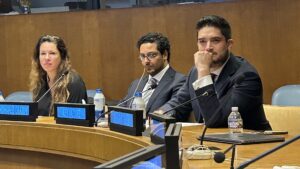
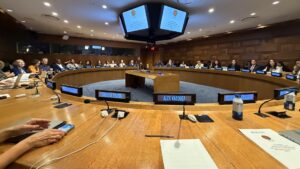
The International Federation for Family Development (IFFD) took part in the United Nations observance of the International Day of Families on Friday, 15 May 2026, held at UN Headquarters in New York. Marked each year on 15 May, the observance this year was dedicated to the theme “Families, inequalities and child wellbeing,”
IFFD was represented at the observance by José Alejandro (Alex) Vázquez, Director of International Relations.
A public observance focused on child wellbeing
Held on the morning of 15 May in Conference Room 8 and open to the public, the observance was opened with introductory remarks by Masumi Ono, Chief of the Social Integration and Participation Branch at DISD/UNDESA. The session featured the launch of a forthcoming report, Families, Inequalities and Child Wellbeing, with key findings presented by Dominic Richardson and colleagues from the Learning for Wellbeing Institute.
The presentations highlighted the relevance of family-oriented policies for achieving child and family wellbeing and addressing inequalities, as well as the urgency of action in the context of global megatrends. They were complemented by good-practice presentations, including one on the evolving global landscape of universal child cash benefits and another on inequality reduction from Mexico, followed by a discussion with audience participation.
IFFD’s message: child wellbeing as a shared responsibility
 For IFFD, the observance was an opportunity to reinforce a message echoed throughout the week: that child wellbeing is a shared public responsibility — essential social and economic infrastructure rather than a purely private family matter — and that investing in families early, from family formation through the earliest years of childhood, is among the most powerful strategies to reduce inequality.
The Federation has consistently argued that the gap between policy design and its real impact on families is itself a form of inequality, and that families do not need to be told what to do, but rather need governments and civil society to remove the economic, digital and social barriers that stand between them and their own potential.
That conviction is grounded in concrete results across IFFD’s network in 68 countries — from the Philippines, where a national law now mandates parenting support for every family, to Kenya, where a National Family Policy is moving toward implementation, to a growing network of more than 250 cities and regions that have signed the Venice Declaration on Inclusive Cities for Sustainable Families, reaching more than 25 million people across Argentina, Brazil, Mexico, Colombia and Europe.
Carrying the message forward
The observance closed a week in which experts, policymakers and civil society organizations exchanged evidence and good practices on reducing inequalities and strengthening family and child wellbeing. The findings shared during the International Day of Families are expected to inform the forthcoming report of the Secretary-General on the follow-up to the thirtieth anniversary of the International Year of the Family and beyond.
As IFFD noted, the architecture is in place and the normative framework is strong. What the world’s families need now is the political will to act at every level — from the conference room to the ground.
—
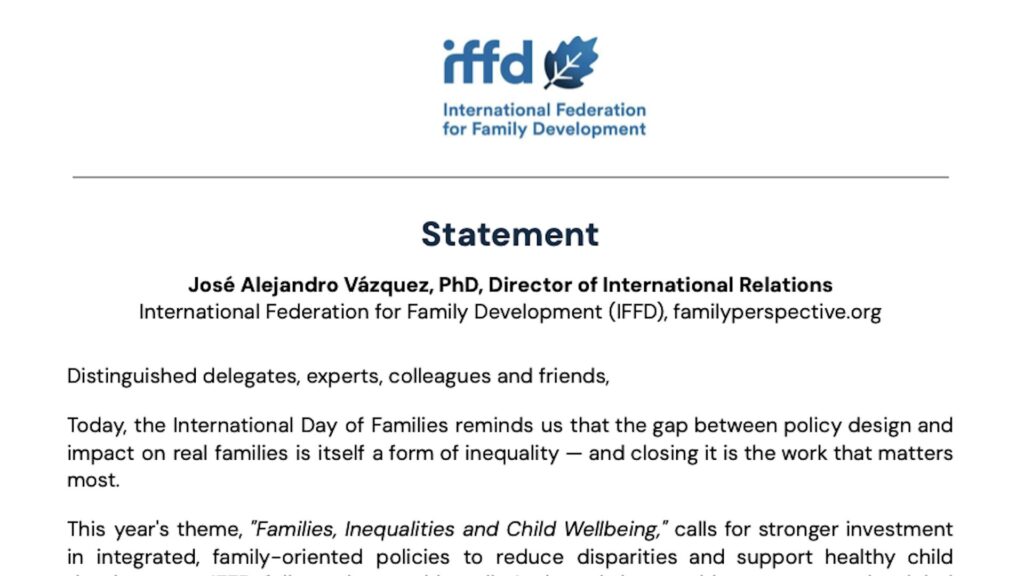
Statement