


New York, 7 October 2026. The International Federation for Family Development (IFFD) has followed the 81st session of the United Nations General Assembly from its opening days, from the High-Level Week to the Third Committee debate on social development, where the family returns to the agenda this week.
 From High-Level Week to the Right to Development
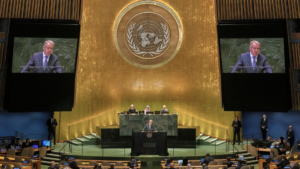
IFFD joined the General Assembly’s High-Level Week in September, when Heads of State and Government gathered in New York to set the tone for the year’s work.
On 23 September, IFFD took part in the High-level Meeting to Commemorate the 40th Anniversary of the Declaration on the Right to Development. Adopted in 1986, the Declaration affirms that every person is entitled to participate in, contribute to and enjoy development.
For IFFD, the anniversary carries a clear message. If the human person is the central subject of development, then the family, where people are born, cared for, educated and empowered, is where that right is first realized or denied.
A voice for families at the Third Committee briefing
As the Third Committee (Social, Humanitarian and Cultural) began its work, its Bureau held a briefing for civil society. Alex Vazquez spoke on behalf of IFFD, a federation present in 68 countries.
Vazquez explained that IFFD promotes family-friendly policies and works with Member States and the UN system to enrich resolutions that touch on families, children, parents and older persons. Its practitioners on the ground then help turn those commitments into practice.
The federation offered one comment and two questions:
1. Appreciation that this year’s session opened at a time when civil society can again enter UN premises, after the High-Level Week.
2. The cost of participation. Civil society organizes events throughout the year that feed the Committee’s discussions. IFFD asked whether the costs of taking part in and organizing events at the UN could be reviewed.
3. Access to informal meetings. IFFD asked how civil society could gain more access to, and presence in, informal meetings, and whether the Bureau has considered ways to make this possible.
 Agenda item 24: the family at the center of social development
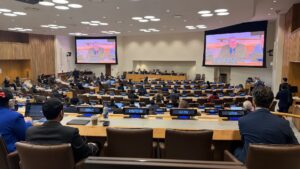
Today the Committee opened its debate on agenda item 24, social development. Charles Katoanga, Director of the Division for Social Development at the UN Department of Economic and Social Affairs, introduced four reports of the Secretary-General.
The first, From commitment to implementation: advancing social development after the Doha Political Declaration (A/81/333), calls for financing that is adequate, predictable and aligned with social priorities, ahead of the first high-level review in 2031.
Of most interest to IFFD was the report Follow-up to the thirtieth anniversary of the International Year of the Family and beyond (A/81/61-E/2026/47). It looks at family policymaking in response to five megatrends: technology, demographics, urbanization, migration and climate change.
Reviewing voluntary national reviews from 2020 to 2024, the report finds that family policies are still underused in overall social policymaking. Katoanga said Member States are urged to:
• support the role of families in designing and implementing family-friendly and gender-responsive policies;
• promote social protection for all families;
• take a holistic approach that positions the family as a central enabler and contributor to social development, as noted in the Doha Political Declaration.
Katoanga also presented the report on the Second World Assembly on Ageing (A/81/212), which examines longevity and its effects on health, employment, social protection and public finances. The fourth report, on inclusive development for and with persons with disabilities (A/81/303), reviews progress in disability inclusion across policies and programmes.
Older persons: needing help without losing control
Also today, Zvezdan Pirtošek addressed the Committee for the first time as Independent Expert on the enjoyment of all human rights by older persons. He presented his report on autonomy, dignity and human rights for older persons in situations of dependency.
Pirtošek argued that dependency is not the opposite of autonomy. People live in relationships of interdependence throughout life, and needing more support does not reduce anyone’s personhood or right to make choices. He called for “rights-realizing systems” that ask not only what care a person needs, but what that person wants.
His message closely echoes IFFD’s work. He described families and informal caregivers as central, providing an enormous share of support in every region. But their contribution, he warned, cannot be treated as an unlimited private resource: caregivers need respite, information, services and social protection.
He also noted that women still carry a disproportionate share of unpaid care. And he linked his report to the elaboration of a new legally binding instrument on the human rights of older persons, now advancing in Geneva after years of work in New York’s Open-ended Working Group on Ageing.
His closing line summed up the report: States should ensure that needing another person never means becoming less of a person.
Next: parenting support in the family resolution
In the coming weeks, Member States will negotiate this year’s resolution on the follow-up to the International Year of the Family. IFFD will support delegations in enriching its language on parenting support.
The proposals build on the resolution’s existing agreed text, which already refers to involved and positive parenting and to parenting education. They draw on the Secretary-General’s new report, which uses the term “parenting support” and links it to early childhood development, educational outcomes and breaking the intergenerational transmission of poverty.
IFFD’s suggestions focus on a few areas:
• Parenting education and support: evidence-based programmes that improve children’s well-being and help prevent violence against children.
• Early childhood: engaging parents and caregivers as active agents in their children’s learning, in line with SDG targets 4.1 and 4.2.
• Digital parenting support: resources that help parents protect children from online harm.
• Care and support systems: systems that strengthen families’ capacity to care for their members, including support for family caregivers.
• The Doha Political Declaration: recalling Member States’ commitment to the family as a central enabler and contributor to social development.
“Agendas are agreed in New York, but they are implemented in homes, neighbourhoods and cities,” IFFD notes. “Our role is to bring real family challenges into the room, and then help put the resulting commitments into practice through our practitioners on the ground.”