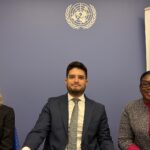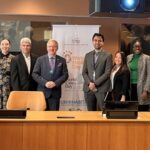


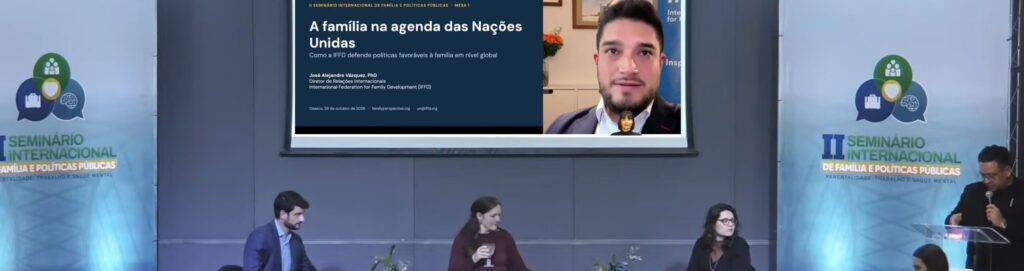
Osasco, Brazil, 29 October 2026. IFFD took part in the II International Seminar on Family and Public Policy: Parenting, Work and Mental Health, organized by the Osasco City Government through its Department of Family, Citizenship and Food Security (Sefam) at the Osasco Commercial and Business Association (ACEO). Dr. José Alejandro Vázquez, IFFD Director of International Relations, spoke on the first panel, “Family and Social Policies: Why Does the Family Matter?”
The panel was moderated by Gisela Solymos, Secretary of Family, Citizenship and Food Security of Osasco. Dr. Vázquez shared it with Marcelo Couto Dias, Secretary of State for Social Development of Minas Gerais, and Professor Elisabetta Carrà of the Università Cattolica del Sacro Cuore in Milan.
From evidence to UN texts
Dr. Vázquez explained how IFFD advocates for family-friendly policies at the United Nations. The strategy has three steps: gather evidence, turn it into policy recommendations, and bring those recommendations into official UN documents. He illustrated it with three examples presented this year at the UN-DESA workshop in Kenya and the Expert Group Meeting in New York: the Philippines’ national parenting law, the municipal programme Familias Vamos Adelante in Envigado, Colombia, and Kenya’s National Action Plan for families.
He also presented IFFD’s 2025 impact figures: 29 advocacy events, about 2,900 participants, 32 countries and 8 UN agencies reached. The 2025 Report of the Secretary-General on families records IFFD’s contributions in nine paragraphs. The UN resolution on the family has grown from 9 paragraphs in 2015 to 42 in 2025, now covering parenting education, work-family balance, care systems and early childhood.
Why the family matters
In the second part of his remarks, Dr. Vázquez argued that the family is where the agendas for women, children, youth, older persons and persons with disabilities meet. He cited two UN-DESA studies. Rosario Esteinou’s review of national SDG reports found that close to 90% mention families, but few countries apply a holistic family perspective. The 2026 report by Dominic Richardson and colleagues shows that families are where inequality passes from one generation to the next, which makes family policy among the most effective investments a country can make. “The family is where policies either come together or fall apart,” Dr. Vázquez said.
Cities closest to families
Addressing a seminar hosted by a city, Dr. Vázquez presented the Inclusive Cities for Sustainable Families project, launched in 2017 by IFFD, UN-DESA and the Veneto Region. More than 260 cities and regions have signed the Venice Declaration. The project’s 2026 Monitoring Report gathers 58 new good practices from 19 signatories in six countries, including Brazil, where Family Talks is the project’s regional delegate.
About the seminar
From 2 p.m. to 7 p.m., the seminar brought together national and international experts, public officials, researchers and civil society representatives. After the opening panel, speakers discussed the impact of parenting and mental health on school performance, and good business practices for work-family balance.
One of the event’s highlights was the launch of the Empresa Mais – Família Seal, developed by Sefam and the Department of Technology, Innovation and Economic Development (Setide). The seal recognizes companies committed to promoting work-family balance, an approach IFFD has long advocated at the UN.
IFFD thanks Sefam, Secretary Gisela Solymos and Dr. Letícia Barbano for the invitation and the coordination of the programme.
The full event can be watched on YouTube: https://www.youtube.com/watch?v=2_PtOK8n7tg
The International Federation for Family Development (IFFD) holds General Consultative Status with ECOSOC and works with families in 68 countries. Learn more at familyperspective.org and citiesforfamilies.org.