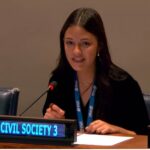


Rocío Ramos, youth representative speaking on behalf of the International Federation for Family Development, addressed the Commission to emphasize that accelerating gender equality requires placing care systems and family dynamics at the center of policy design.
She highlighted that, thirty years after the Beijing Declaration and Platform for Action, persistent gender inequality is closely linked to how care is organized, valued, and distributed within households. Drawing on global evidence, she underscored that women continue to perform the majority of unpaid care work more than three times as much as men, limiting their access to employment, economic independence, and leadership opportunities. Referring to SDG Target 5.4, she stressed that real progress requires not only recognizing care, but also reducing and redistributing it through integrated policies, including childcare services, parental leave, and family-friendly workplaces.
Her intervention emphasized that a family perspective is essential to understand how inequalities are reproduced and how meaningful change can occur. She called for a balanced approach that supports both caregivers, through social protection, flexible work, and greater male involvement, and care recipients, including children, older persons, and persons with disabilities, whose rights and dignity must remain central. She concluded by urging stronger investment in care systems, improved data on unpaid care, and coordinated action across governments, the private sector, and civil society, stressing that transforming how care is shared and supported is key to achieving gender equality and sustainable development.
Loading Viewer...