

The study was implemented in July 2025, motivated by the increasing number of older adults and rising life expectancy in Europe, making the challenges of aging a pressing social issue. The project was designed in preparation for the Second World Summit for Social Development and led by ISRAA (Istituto per Servizi di Ricovero e Assistenza agli Anziani), IFFD (International Federation for Family Development) as part of its Advocacy Training project, and IPC – Facultés libres de Philosophie et de Psychologie, with Erasmus+ European Programme support. The core aim was to understand and identify the unmet needs and living conditions of people aged 65 and over in Treviso, focusing especially on their inclusion within family and society, and to inform local social policy with practical recommendations.

The work adopted a mixed-methods design, combining a 24-question quantitative survey with a qualitative focus group to capture both broad trends and personal experiences of older adults. The survey, carefully tailored for accessibility and relevance, was distributed online and in person through emails to local associations, sharing on social platforms, and collaboration with pharmacies to reach less digitally literate individuals; assistance and paper copies were also provided. Respondents were grouped into three age cohorts (65–74, 75–84, 85+) and answered thematic sections addressing access to essential services, social connections, physical and mental health, financial independence, and technology use. Complementing this, a focus group with 20 participants provided richer insights and helped validate the survey results. The entire process was anonymized, with respect for privacy and the option to skip sensitive questions, thereby ensuring ethical research standards.

The study highlights significant disparities in access to essential services—such as healthcare, transportation, green spaces, home adaptation, and technology—that vary by age group and municipality. Social isolation and economic insecurity emerge as pressing concerns, particularly for those over 85, who face unmet housing needs, limited financial resources, and restricted social support. Access to public services is further hindered by complex administrative processes, digital barriers, and lack of information, making family networks the primary, often unpaid, source of care. Life satisfaction is closely linked to good health, autonomy, active relationships, and financial independence, while poor health, loneliness, and limited engagement predict lower well-being. Finally, the rapid digitalization of services creates a growing divide, as the oldest cohorts remain least familiar with digital tools, underscoring the importance of inclusion measures to ensure access and social connection.

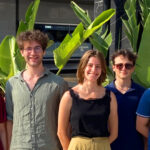
The four authors of the study.
To address the root causes of marginalization and improve the daily lives of seniors, particularly the most vulnerable, the study recommends enhancing accessibility through improved public transport and the creation of dedicated local centers, alongside housing assistance programs to support home adaptations such as elevators, air conditioning, and emergency systems. Administrative processes should be simplified, with the introduction of AI-based daily assistants designed for seniors to ease communication, access to information, and practical support. Social inclusion can be strengthened by promoting intergenerational activities, media campaigns that highlight the contributions of older adults, school visits to elderly institutions, and intergenerational housing initiatives. In parallel, the development of supervised walking groups and age-adapted sports programs is advised to foster physical activity and well-being. Finally, the report underscores the importance of recognizing and valuing a human, gratuitous form of care, rooted in attention to others rather than utilitarian logic, while ensuring greater visibility and societal inclusion of older persons.